Rarity
Common, Uncommon, Rare, Epic, or Legendary. Rarity determines the item's underlying sophistication and modification capacity.
Equipment is a core part of life on ruined Mandalore. Find gear in the field, decide what is worth saving, repair what survived, and turn scavenged technology into equipment that becomes your own.
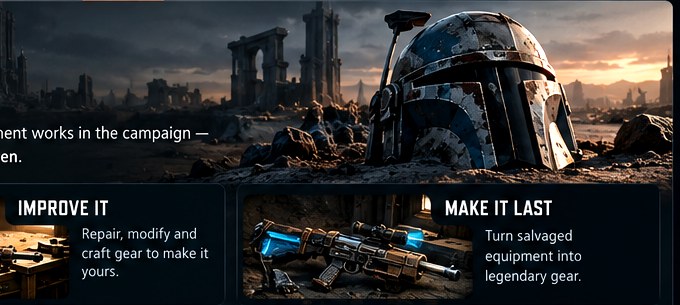
Every significant piece of equipment is easy to read: Rarity tells you how advanced it is, Condition tells you whether it works, and Mods tell you how it has been customized.

Common, Uncommon, Rare, Epic, or Legendary. Rarity determines the item's underlying sophistication and modification capacity.
Functional works normally. Damaged works with one Fault. Broken cannot perform its primary function until repaired.
Physical upgrades installed into an item's modification slots. Mods are loot, crafting projects, rewards, and trade goods.
Rarity describes the underlying design. It determines the item's general power, value, crafting difficulty, and modification slots.
Ordinary equipment and straightforward technology.
Specialized or improved equipment.
Advanced military or corporate technology.
Exceptional technology rarely encountered.
Prototype, masterwork-era, or historically significant technology.
Condition is deliberately simple. Equipment has only three states.
No penalties and no Fault.
The item remains usable, but its Fault creates a specific complication until repaired.
The item cannot perform its primary function until repaired. It may still be salvaged or studied.
A damaged rifle might have a burned heat sink; damaged armor might have a compromised seal. Faults describe what is actually wrong instead of simply applying a blanket −1 or −2.
Mods are physical upgrades. They occupy slots determined by rarity and can be found, crafted, traded, installed, or removed.
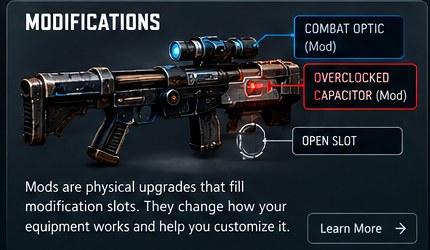
A Caedran Combat Optic, Kordax Overcharged Capacitor, or Ordo Reinforced Receiver can be removed from one compatible item and installed in another.
At a workstation: installing or removing a compatible mod normally requires no check.
In the field: the GM may call for an appropriate crafting check.
Rare • Functional • Mods 2/3
Caedran Combat Optic · Kordax Recoil Compensator · 1 Open Slot
Crafting should create decisions, not bookkeeping.
| Rarity | DC | Typical Time |
|---|---|---|
| Common | 10 | 1 hour |
| Uncommon | 12 | 2 hours |
| Rare | 15 | 4 hours |
| Epic | 18 | 8 hours |
| Legendary | 22 | Downtime Project |
The item is completed and its listed components are consumed.
The item is not completed. Lose one component chosen by the GM, replace it, and try again.
Quality only appears when an item is exceptional. Most equipment is Standard and does not need a quality label.
When crafting, attempt the recipe at +3 DC. On success, choose 1 Craftsmanship Trait. If you meet the normal DC but miss the Refined DC, you still create the Standard item.
A Refined item can later undergo a Masterwork Upgrade at a proper workstation. Use +5 DC. On success, add a second different Craftsmanship Trait.
Unusually resistant to developing Faults or becoming Damaged.
Substantially harder to physically destroy.
Weight or encumbrance is reduced roughly by half.
Consumes ammunition, charges, fuel, or expendables more efficiently.
Gains +1 modification slot.
Unusually easy to hide, stow, or transport.
A weapon built for improved handling.
A weapon resistant to overheating and heat-related Faults.
Armor custom-built to reduce problems caused by bulk or extended wear.
Armor better protected against dust, smoke, weather, and hostile environments.
Armor/materials designed to reduce noise during movement.
Electronics are especially accurate and resistant to interference.
Electronics resist ion effects and technological disruption.
Tools/electronics are smaller without sacrificing their function.
Basic functions are easier for unfamiliar users to operate.
Repairs use the item's appropriate crafting discipline and sensible replacement components.
Use appropriate tools, replacement components, and one crafting check to remove the item's Fault.
Requires more components, a proper workstation, and a harder crafting check. One successful repair restores the item directly to Functional.
Any piece of technology can become tomorrow's components.
Success: recover the item's useful components.
Failure: recover fewer components.
There are no percentage-yield tables to track. The item's recipe and the GM determine which useful parts survive.
Installed modifications can be extracted before the base item is dismantled, making damaged gear valuable even when nobody wants the item itself.
Reverse engineering is intentionally a single meaningful choice rather than another progression track.
| Rarity | Reverse Engineering DC |
|---|---|
| Common | 10 |
| Uncommon | 12 |
| Rare | 15 |
| Epic | 18 |
| Legendary | 22 |
Broken items must first be restored enough to study. Finding a schematic directly as loot skips this process entirely.
Manufacturers are story-driven. They create distinctive technology, proprietary equipment, unique modifications, corporate facilities, and adventure hooks. There is no manufacturer knowledge XP or familiarity track.
Heavy weapons, recoil, heat, and overcharging.
Adaptive droids and learning systems.
Industrial equipment, reinforcement, and repairability.
Armor, shielding, and defensive systems.
Vehicles, mobility, and maneuverability.
Sensors, targeting, shields, and electronics.
Improvised technology and unusual compatibility.
1. What rarity is it?
2. Is it Functional, Damaged, or Broken?
3. What mods are installed?
4. Keep, repair, modify, salvage, reverse engineer, or trade it.
Common 10 · Uncommon 12 · Rare 15 · Epic 18 · Legendary 22
Refined: +3 DC / 1 Trait
Masterwork upgrade: +5 DC / second Trait
Functional: works normally.
Damaged: works with one Fault.
Broken: does not work until repaired.
Common 1 · Uncommon 2 · Rare 3 · Epic 4 · Legendary 5